 Merytt
Your result
You are the Gatekeeper.
“I check everything before it goes out.” You hired, and you still read everything before it goes out. Nothing passes without you, before or after.
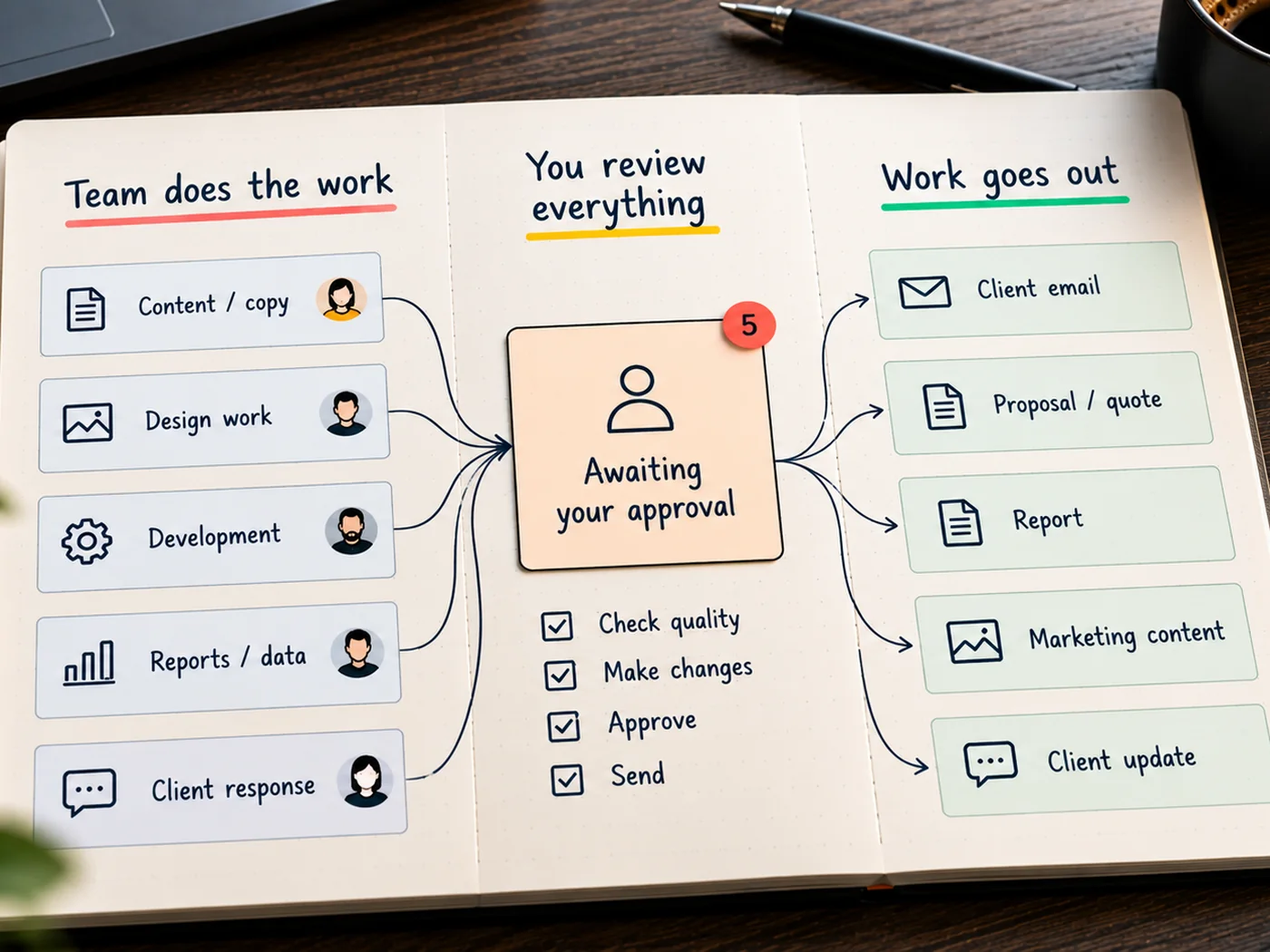
At this stage, you typically:
- You have hired, and the team can produce the work.
- You still read most of it before it goes out.
- What you are checking for is real, and it has never been written down.
- You want to hand the checking over without lowering the bar.
Where this sits
- 01DoerGet organised and remove friction.
- 02GatekeeperStop being the last gate before work goes out.
- 03TeacherHand over the judgement, not only the task.
- 04StandardMake it run without you watching.
- 05ArchitectMake it travel, and choose what is next.
Five stages, from six questions. They are stages, not scores.
Recommended next step
A first call is thirty minutes with a founder and costs nothing. No email needed for the pack.
You know what good looks like. Nobody else can see it.
Those feel like three different places to be. They are the same one. Nothing can go out without somebody checking it against a standard that lives in one head, and nothing starts without somebody asking first. Same problem, two ends.
There is a folder somewhere, and it died.
- 1.How we take on a job
- 2.Who signs it off
- 3.How we invoice
- ·Ask Sam firstNot in the document
- ·Use the new supplierChanged in March
- ·Approval comes from Jo nowNobody updated it
Illustrative example · the document stopped changing, the business did not
A handbook from when you hired the third person. A shared page. An onboarding document. It stopped being true, people stopped opening it, and you decided writing a business down does not really work.
It does work. Yours died for three reasons, and the first two are not your fault.
One. You wrote the steps, not the decisions.
They treat the people using the tools as dumb and try to spell out every single step. They turn people’s brains off rather than turn them on.
Atul Gawande, The Checklist Manifesto (2009), on what Daniel Boorman of Boeing taught him about bad checklists.
Steps are the easy half. Anybody can follow “attach the file, copy the address, press send”. What nobody can follow is the reason you would not send it at all.
Two. The part that mattered, you could not say.
We can know more than we can tell.
Michael Polanyi, The Tacit Dimension (1966).
You did not leave the important bit out because you were rushing. You left it out because it is hard to find words for something while you are busy doing it. That happens to everybody who is good at something.
Three. A document just sits there.
Say you fix both. You write the decisions and you find the words. The document is right, and it still will not work, because somebody has to remember it exists and read the right part at the moment they are busiest. So they ask you instead.
The first two are writing problems, and the free pack fixes them. The third is what we fix.
We put your standard where the work happens.
It starts with your Roadmap. We read what your business runs on, write down what is in the way, and recommend one build with its price.
The build puts your rules into the tools you already use. Then, on the monthly, we run Pulse for you. It notices what needs attention and does the work in your words. You choose what it may send on its own, and what waits for a person.
The standard stops living in one head, and it stops mattering who is in the chair on Monday.
Investment How it works
A clear path. A simpler decision.
Start with the Roadmap to get clarity, then move into the build when you are ready. If you go ahead inside the credit period, some or all of the Roadmap fee comes off the build.
-
01
Roadmap
Clarity before you commit
- Understand where you are
- What to fix, and in what order
- A clear plan, costs and next steps
From€3,500
-
02
Build
Turn the plan into reality
- Build what the Roadmap names
- Into the tools you already use
- The last payment waits until it works
From€12,000
-
03
Run
We keep it running
- Your engines kept running
- With Pulse, the AI inside them
- Nobody on your side has to log in
From€3,000a month
The first call is free. The monthly has a three-month minimum, then 30 days’ notice.
Bring the thing you always end up checking.
Thirty minutes with a founder, free. If the honest answer is that you should do it yourself, we will say so on the call.